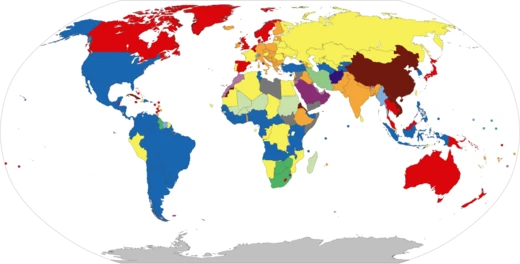
President (government title)
Title for head of state in most republics.
The title "president" is widely used for the head of state in most republics, though what a president actually does differs from country to country. Some presidents run the government, others serve as ceremonial figureheads, and some fall somewhere in between. How much power a president holds depends on the type of government: in parliamentary republics, the role is often mostly ceremonial, though exceptions exist in presidential-parliamentary systems (like Botswana and South Africa) where the president has more executive duties. In semi-presidential republics, the president has certain discretionary powers—such as handling foreign affairs or appointing heads of agencies—but is not the head of government. Leaders of one-party states may also take the title of president for ceremonial reasons or to hold an official state position.
Forms of address like "Mr. President" or "Madam President" are used for people holding this title, as well as for those presiding over certain other government bodies. "Mr. President" has become a standard way for governments to refer to their heads of state. It is also the conventional translation of non-English titles, such as *Monsieur le Président* for the French president. Historically, it has been used for the presiding officers of legislatures and courts. For instance, the speaker of the House of Commons of Canada is called *président(e) de la Chambre des communes* in French and "Mr. Speaker" or "Madam Speaker" in English.
The word "president" comes from Latin *prae-* ("before") and *sedere* ("to sit"). It appears in the original Latinate Douay–Rheims Bible, notably for Pontius Pilate in Matthew 27, and the plural "presidents" in the King James Bible at Daniel 6:2 translates an Aramaic term of Persian origin meaning "officials" or "chiefs." Originally, it referred to someone who presides over or "sits before" a gathering to keep order (similar to "chairman" or "speaker"), but today it most often means an executive official in any organization. Early examples include its use at Oxford and Cambridge universities (from 1464) and for the founding president of the Royal Society, William Brouncker, in 1660. This older sense survives in titles like "President of the Board of Trade" and "Lord President of the Council" in the UK, as well as "President of the Senate" in the US (a role held by the vice president). In some Anglican ser
- Etymology
- Latin prae- 'before' + sedere 'to sit'
- First government usage
- Commonwealth of England
- First modern republic usage
- United States Constitution of 1787
- Common styles
- Mr. President, Madam President
- Related titles
- Speaker, Chairman, Lord President
Lore & Background
The title president is derived from the Latin prae- 'before' + sedere 'to sit'. It originally designated the officer who presides over or 'sits before' a gathering. Early examples include universities of Oxford and Cambridge from 1464 and the founding president of the Royal Society, William Brouncker, in 1660. The word is also used in the Douay–Rheims Bible to translate the title for Pontius Pilate, and the plural 'presidents' appears in the King James Bible at Daniel 6:2.
Reader's Guide
The most common modern usage of president is as the title of a head of state in a republic. The first usage of the word to denote the highest official in a government was during the Commonwealth of England. The modern usage to designate a single person who is the head of state of a republic can be traced directly to the United States Constitution of 1787, which created the office of president of the United States. It has been suggested that the executive use of the term was borrowed from early American colleges and universities, which were usually headed by a president. The title 'Mr. President' is borrowed from British Parliamentary tradition, where the presiding Speaker of the House of Commons is referred to as 'Mr. Speaker'. In France, 'Monsieur le Président' became the title of the president of the French Republic when the Second French Republic was established in 1848.
Did You Know?
- The title president is derived from Latin prae- 'before' + sedere 'to sit'.
- The first usage of the word president to denote the highest official in a government was during the Commonwealth of England.
- The modern usage of president as head of state of a republic can be traced directly to the United States Constitution of 1787.
- In pre-revolutionary France, the president of a Parlement evolved into a powerful magistrate with judicial and administrative authority.
More in Forms Of Government 1-20
Spotted an error? Know more?
This is a living reference — every entry is fact-audited, and reader corrections feed straight into our audit queue. Suggest an edit · See this site's audit record