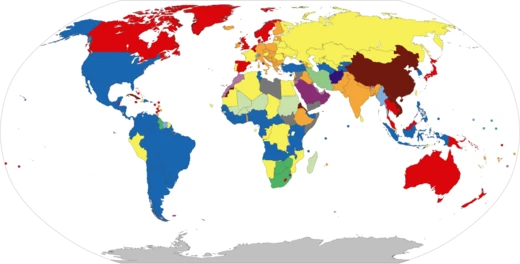
Monarchism
Advocacy of monarchy as a system of government.
Monarchism is the belief in and support for monarchy as a system of government. A monarchist backs the institution itself, regardless of who holds the throne, while a royalist is loyal to a specific monarch. The opposing view, which favors a republic, is known as republicanism. Monarchy is one of the oldest forms of political organization, with its origins in prehistoric chiefdoms and tribal kingship. These early hierarchies laid the groundwork for state formation in ancient civilizations such as Mesopotamia, Egypt, and the Indus Valley, and in some regions, chiefdoms evolved into full monarchies. During the 17th and 18th centuries, Enlightenment thinking sparked new anti-monarchist ideas, leading to revolutions like the American and French Revolutions, which further eroded the power of European monarchs.
In Africa, one of the world’s oldest monarchies ended in 1974 when Emperor Haile Selassie was overthrown in Ethiopia. In Asia, China was largely organized under hereditary dynasties for most of its history, starting with Yu the Great around 2070 BC and ending with the abdication of the Xuantong Emperor in 1912. Chinese historiography traditionally structures itself around these successive dynasties, which were sometimes founded by non-Han peoples. Japan’s emperor, known as the Tennō or “heavenly sovereign,” is a hereditary monarch and head of state. The Imperial Household Law sets the line of succession, and the emperor is immune from prosecution while also serving as the head of Shinto, believed to be a descendant of the sun goddess Amaterasu. Tradition dates the office to the 7th century BC, but modern scholars place its true emergence in the 5th or 6th centuries AD. During the Kamakura period (1185–1333), shōguns were the de facto rulers, with the emperor as a figurehead. In 1867, Shogun Tokugawa Yoshinobu resigned, restoring Emperor Meiji to power. The 1889 Meiji Constitution gave the emperor active political power shared with the Imperial Diet. After World War II, the 1947 Constitution redefined the emperor as a symbol of the state and national unity, with a purely ceremonial role ever since.
In Europe, after Austria-Hungary collapsed, the Republic of German-Austria was proclaimed, and the Habsburg Law permanently exiled the Habsburg family. Despite lingering support for the Habsburgs, monarchist activity was suppressed by the Nazi regime after the 1
- field
- Political ideology
- known_for
- Advocacy of hereditary monarchical rule
- related_concepts
- Royalism, republicanism
- historical_scope
- Prehistoric to present
Lore & Background
Monarchical rule is among the oldest political institutions, with prehistoric chiefdoms providing the concept of state formation in civilizations such as Mesopotamia, Ancient Egypt, and the Indus Valley. In the 17th and 18th centuries, the Enlightenment produced anti-monarchist ideas that led to revolutions like the American and French Revolutions, weakening European monarchies. In 1974, one of the world's oldest monarchies was abolished in Ethiopia with the fall of Emperor Haile Selassie.
Reader's Guide
Monarchism has been a persistent force across continents, from the dynastic states of China, organized under hereditary monarchs from c. 2070 BC to 1912, to the Japanese imperial line, which tradition dates to the 7th century BC but scholars believe began in the 5th or 6th centuries AD. In Europe, monarchist movements saw varied fates: the Habsburg Law exiled the family from Austria after World War I, and support evaporated after Nazi rule; in Germany, the German National People's Party demanded return of the Hohenzollern monarchy until Nazism rose; Italy's 1946 referendum narrowly chose a republic over monarchy. Spain's monarchy was restored in 1975 under King Juan Carlos after Franco's regime. In the United Kingdom, monarchy evolved into a ceremonial role after the Glorious Revolution, with Queen Elizabeth II enjoying wide support. In the Americas, monarchist factions fought in Costa Rica's 1823 civil war, and Mexico briefly had two empires before republicans executed both emperors. Monarchism remains a minority advocacy in some places, such as Mexico, where organizations propose claimants to a throne.
Did You Know?
- In 1974, one of the world's oldest monarchies was abolished in Ethiopia with the fall of Emperor Haile Selassie.
- The Japanese emperor is recognized as the head of the Shinto religion and a direct descendant of the sun goddess Amaterasu.
- In 1215, English nobles forced King John to sign Magna Carta, establishing that the king's powers were not absolute.
- The 1947 Constitution of Japan defines the emperor as the symbol of the Japanese state, with a purely ceremonial role.
More in Forms Of Government 1-20
Spotted an error? Know more?
This is a living reference — every entry is fact-audited, and reader corrections feed straight into our audit queue. Suggest an edit · See this site's audit record