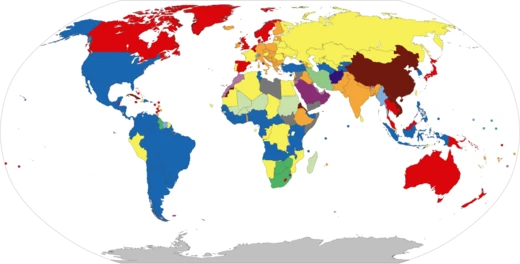
Legislature
A deliberative assembly with authority to make law.

Wikipedia / Wikimedia Commons
A legislature is a deliberative body with the legal power to create laws and oversee political matters within a state, nation, or city. It is one of the main institutions of government, usually set apart from the executive and judicial branches. Legislatures can operate at various levels, including national, subnational (such as state, provincial, or regional), local, or supranational levels, like the European Parliament.
In most political systems, the laws passed by a legislature are called primary legislation. Legislatures also handle oversight, budgeting, and representation. Their members, known as legislators, can be elected, indirectly chosen, or appointed. Depending on the constitution, a legislature may have one chamber (unicameral), two chambers (bicameral), or more (multicameral).
Different types of legislatures exist, based on how a state organizes power. These types reflect not just structure and function, but also the legislature’s constitutional relationship with other institutions and the underlying theories of sovereignty. Common types include parliaments, which operate under a fusion of powers between the executive and legislature; congresses, which function under a separation of powers among independent branches—here, the legislature is institutionally separate and has limited influence over other branches; and supreme state organs of power (SSOPs), found in communist states, which follow a doctrine of unified power. In SSOPs, all state powers—executive, legislative, judicial, and others—are centralized in a single supreme organ, with subordinate bodies carrying out delegated tasks within a constitutionally defined division of labor.
In liberal democracies, two main types of legislatures exist: parliaments and congresses. Parliaments are found in systems with a fusion of powers, while congresses appear in systems with a separation of powers. Other types, like SSOPs, exist in communist states under unified power. The key difference between these types, according to scholar Amie Kreppel, is the relationship between the legislature and the executive.
In parliamentary democracies, the government—made up of a prime minister and cabinet—is elected by the legislature, and its members come from within the parliament. Although the government is a distinct institution, it is accountable to the legislature, meaning the legislature can theoretically
- Type
- Deliberative assembly
- Primary function
- Making law and exercising political oversight
- Common names
- Parliament, Congress, Council, Diet, Assembly, Supreme state organ of power
- Members called
- Legislators
- Selection methods
- Elected, indirectly chosen, or appointed
- Structural forms
- Unicameral, bicameral, or multicameral
Lore & Background
Legislatures have existed in various forms throughout history. Among the earliest recognised formal legislatures was the Athenian Ecclesia. In the Middle Ages, European monarchs would host assemblies of the nobility, which later developed into predecessors of modern legislatures, often named the Estates. The oldest surviving legislature is the Icelandic Althing, founded in 930 CE.
In liberal democratic systems, two main types of legislatures exist: parliaments and congresses. Parliaments operate under the fusion of powers between the executive and the legislature, where the government is elected by and accountable to the legislature. Congresses function under the separation of powers, with the legislature institutionally separate from the executive and having limited means to influence its operations. A third type, the supreme state organ of power (SSOP), exists in communist states, operating under the doctrine of unified power, centralizing all state powers in a supreme organ with subordinate organs carrying out delegated functions.
The relationship between the legislature and the executive is the most important distinguishing feature between types of legislatures. In parliamentary systems, this relationship is characterized by mutual dependence, while in separation of powers systems, the boundaries between government branches are clearly demarcated. In communist states, the SSOP is constrained only by limits it has itself set, and other state organs derive their powers from and are subordinated to it.
Reader's Guide
Legislatures are fundamental institutions in political systems worldwide, serving as the primary bodies for lawmaking and political oversight. Their significance lies in their role as representative assemblies that translate popular will into legal frameworks. The type of legislature—whether parliament, congress, or supreme state organ of power—reflects the constitutional principles of power on which a state is organized. Parliaments, found in systems practicing fusion of powers, create a relationship of mutual dependence between the legislature and executive, where the government is accountable to the legislature. Congresses, operating under separation of powers, maintain clear institutional boundaries between branches, with limited ability for the legislature to remove the executive. Supreme state organs of power in communist states centralize all state authority, subordinating other organs and rejecting separation of powers in favor of a division of labor. Democratic legislatures typically perform six major functions: representation, deliberation, legislation, authorizing expenditure, making governments, and oversight. The specific names and roles of legislatures vary by country, but they all aim to serve the purpose of appointing officials to represent citizens and determine appropriate legislation. Understanding the type of legislature in a given political system provides insight into the distribution of power, the relationship between branches of government, and the underlying theories of sovereignty that shape governance.
Did You Know?
- The oldest surviving legislature is the Icelandic Althing, founded in 930 CE.
- Legislatures may be unicameral, bicameral, or multicameral depending on constitutional design.
- In communist states, the supreme state organ of power operates under the doctrine of unified power, centralizing all state powers.
- The most important distinguishing feature between types of legislatures is the relationship between the legislature and the executive.
More in Forms Of Government 1-20
Spotted an error? Know more?
This is a living reference — every entry is fact-audited, and reader corrections feed straight into our audit queue. Suggest an edit · See this site's audit record