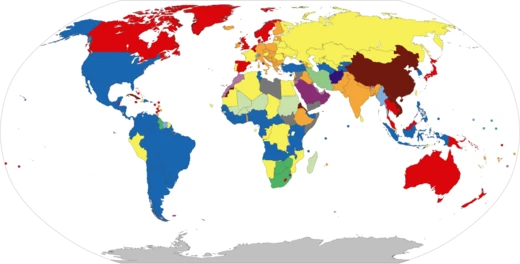
Local government
Lowest tier of governance within a sovereign state.

Wikipedia / Wikimedia Commons
Local government is a generic term for the lowest tiers of governance or public administration within a particular sovereign state. It typically constitutes a subdivision of a higher-level political or administrative unit, such as a nation or state, and acts within powers assigned by law or directives of a higher level of government. The institutions of local government vary greatly between countries, with common designated names including counties, districts, cities, townships, towns, boroughs, parishes, municipalities, municipal corporations, shires, villages, and local government areas.
- definition_provider
- International Monetary Fund (IMF)
- definition
- Institutional units whose fiscal, legislative, and executive authority extends over the smallest geographical areas distinguished for administrative and political purposes.
- common_types
- Counties, districts, cities, townships, towns, boroughs, parishes, municipalities, municipal corporations, shires, villages, local government areas
- special_types
- Special-purpose local governments (special districts) such as independent school districts, elected water boards, or local service districts
- key_characteristic
- Ability to appoint own officers independently of external administrative control and to raise and spend some funds on own initiative
Lore & Background
Other definitions for local governments are less prescriptive and emphasize the political or representative nature of local governments. For instance, OECD defines local governments as 'decentralized entities whose governance bodies are elected through universal suffrage and which has general responsibilities and some autonomy with respect to budget, staff and assets.' The Local Public Sector Alliance defines local government institutions as 'a corporate body (or institutional unit) that performs one or more public sector functions within a [local] jurisdiction that has adequate political, administrative, and fiscal autonomy and authority to respond to the needs and priorities of its constituents.'
Reader's Guide
Local government is significant as the level of governance closest to citizens, responsible for a wide range of local services and often acting as agents of central or regional governments. The IMF definition provides a precise framework for distinguishing local governments from other levels, emphasizing their fiscal, legislative, and executive authority over the smallest administrative areas. Local governments are often heavily dependent on grants from higher levels of government, yet they must be able to appoint their own officers and raise and spend some funds on their own initiative to be treated as a separate level of government. Questions regarding the empowerment of local government institutions, the structure and nature of local political leadership, and the extent of local self-governance and municipal autonomy are key questions of public administration and governance. Local elections are held in many countries. The variation in terminology and institutional features across countries—such as Egypt's centralized system of local administration with appointed governors, Mali's ambitious decentralization program with elected communal councils, Nigeria's three-tier federal system with democratically elected local government heads, and South Africa's two-tiered system with metropolitan and district municipalities—illustrates the diverse ways local government is organized worldwide.
Did You Know?
- The IMF defines local governments as 'institutional units whose fiscal, legislative, and executive authority extends over the smallest geographical areas distinguished for administrative and political purposes.'
- Local governments may be known by names such as city council, town council, town board, community council, borough council, rural council, village council, board of aldermen, or board of selectmen.
- In federal states, local government generally comprises a third or fourth level of government, whereas in unitary states, it usually occupies the second or third level.
- Some countries have special-purpose local governments (special districts), such as independent school districts, elected water boards, or local service districts.
More in Forms Of Government 1-20
Spotted an error? Know more?
This is a living reference — every entry is fact-audited, and reader corrections feed straight into our audit queue. Suggest an edit · See this site's audit record