Government
System or group leading a state with socially acceptable force.

Wikipedia / Wikimedia Commons
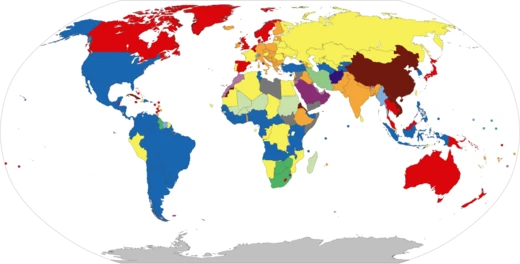
A government is the system or group of people that runs a state, and it holds the sole authority to use force in a socially accepted way. These systems have taken many shapes, from rule by a single person (autocracy), to a small elite (oligarchy), or by the general population (democracy). Today, the main recognized political systems are democracies, totalitarian regimes, and authoritarian regimes, which fall between the two, along with various hybrid forms.
- Earliest known governments
- About 5,000 years ago, first small city-states appeared
- Key ancient examples
- Sumer, ancient Egypt, Indus Valley civilization, Yellow River civilization
- Major modern forms
- Democracies, totalitarian regimes, authoritarian regimes, hybrid regimes, monarchies
- Etymology
- From Greek verb κυβερνάω (kubernáo) meaning to steer with a rudder
- Classification challenge
- Self-identification is not objective; de facto forms often differ from de jure forms
Lore & Background
The moment and place that human government developed is lost in time, but history records early formations. About 5,000 years ago, the first small city-states appeared. By the third to second millenniums BC, some had developed into larger governed areas: Sumer, ancient Egypt, the Indus Valley civilization, and the Yellow River civilization. One reason for the emergence of governments includes agriculture, which created food surplus and enabled specialization, including ruling over others. Governments gradually became more complex as agriculture supported larger populations, creating new interactions and social pressures to control.
Reader's Guide
Starting at the end of the 17th century, the prevalence of republican forms of government grew, with the English Civil War, Glorious Revolution, American Revolution, and French Revolution contributing to representative forms. The Soviet Union was the first large country to have a Communist government. Since the fall of the Berlin Wall, liberal democracy has become even more prevalent. In the nineteenth and twentieth centuries, there was a significant increase in the size and scale of government at the national level, including regulation of corporations and development of the welfare state. Identifying a form of government can be challenging because many political systems originate from socio-economic movements, and parties often name themselves after those ideologies. Opinions vary by individuals concerning types and properties of governments; 'shades of gray' are commonplace. Even the most liberal democracies limit rival political activity, while the most tyrannical dictatorships must organize a broad base of support, creating difficulties for pigeonholing governments into narrow categories.
Did You Know?
- The word 'government' derives from the Greek verb κυβερνάω (kubernáo) meaning to steer with a rudder.
- Plato in The Republic divided governments into five basic types: aristocracy, timocracy, oligarchy, democracy, and tyranny.
- The Soviet Union was the first large country to have a Communist government.
- The quality of a government can be measured by the Government effectiveness index, relating to political efficacy and state capacity.
More in Forms Of Government 1-20
Spotted an error? Know more?
This is a living reference — every entry is fact-audited, and reader corrections feed straight into our audit queue. Suggest an edit · See this site's audit record