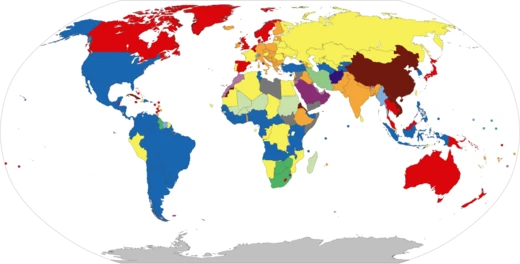
Parliamentary system
Government based on parliamentary confidence and fusion of powers.
A parliamentary system is a type of government where the executive branch draws its authority from the legislature. The head of government, typically called a prime minister, must maintain the support of a majority in parliament to stay in power. This differs from presidential systems, where a separately elected president holds executive power and cannot be removed by a simple legislative vote. The head of government is usually distinct from a ceremonial head of state, such as a monarch in a constitutional monarchy or a president in a parliamentary republic. In many cases, the head of government is a member of parliament, often from the lower house in bicameral systems. The head of state in a parliamentary republic is usually elected by popular vote, though some are chosen by an electoral college or by parliament itself. This system is common across the European Union, Oceania, and many former British colonies, with additional examples in Africa and Asia. A similar model, the council–manager government, is used by many local governments in the United States.
The origins of parliaments lie in medieval Europe. The earliest known assembly, the Icelandic Althing, met around 930, though it left no written records. The first documented parliament separate from the general population, convened in the presence of a king, was the Cortes of León in 1188 under Alfonso IX. The Corts of Catalonia later became the first European parliament with the official power to pass laws. During the Dutch revolt in 1581, the States General of the Netherlands took over sovereign, legislative, and executive powers from King Philip II of Spain. In England, Simon de Montfort convened two key parliaments: one in 1258 that limited royal authority, and another in 1265 that included ordinary citizens from towns. By the 17th century, the English Parliament developed ideas of liberal democracy, culminating in the Glorious Revolution and the Bill of Rights of 1689. In Great Britain, the monarch originally chaired the cabinet, but King George I’s inability to speak English led to the prime minister, Robert Walpole, taking that role. The expansion of voting rights increased Parliament’s control over government, and the Great Reform Act of 1832 solidified parliamentary dominance in choosing the prime minister. This evolved into the Westminster system, where the executive answers to the lower hous
- type
- Form of government
- key_feature
- Fusion of powers; executive accountable to parliament
- head_of_government
- Usually prime minister, almost always a member of parliament
- head_of_state
- Constitutional monarch or ceremonial president (in parliamentary republics)
- contrast
- Presidential or assembly-independent systems
- earliest_example
- Icelandic Althing (c. 930) or Cortes of León (1188)
Lore & Background
In England, Simon de Montfort convened two famous parliaments: the first in 1258 stripped the king of unlimited authority, and the second in 1265 included ordinary citizens from towns. In the 17th century, the Parliament of England pioneered ideas of liberal democracy, culminating in the Glorious Revolution and the Bill of Rights 1689. In the Kingdom of Great Britain, King George I's inability to speak English led to the leading minister, Robert Walpole, chairing cabinet, becoming the first prime minister. The Great Reform Act 1832 led to parliamentary dominance, with Parliament deciding who was prime minister. Other countries gradually adopted the Westminster system, with an executive answerable to the lower house of a bicameral parliament.
Reader's Guide
Parliamentary systems are significant because they represent a model of government where the executive is directly accountable to the legislature, contrasting with presidential systems where power is balanced among branches. This system spread through the former British Empire and was adopted by many countries after World War I and World War II, often imposed by victorious Allies on defeated nations. The Westminster system, characterized by adversarial debate and plurality voting, is common in Commonwealth nations, while consensus systems are found in Western Europe. Parliamentary systems may be bicameral or unicameral, and may be constitutional monarchies or parliamentary republics. A 2019 meta-analysis found that parliamentary systems tend to rely more on fiscal expansion with higher spending before elections, while presidential systems favor revenue cuts. The system's flexibility—allowing for ceremonial heads of state and elected prime ministers—has made it the predominant form of government in many regions.
Did You Know?
- The earliest written record of a parliament called in the presence of a king was the Cortes of León in 1188.
- The Corts of Catalonia were the first European parliament to officially obtain the power to pass legislation.
- King George I's inability to speak English led to Robert Walpole becoming the first prime minister.
- A 2019 meta-analysis found that parliamentary systems tend to rely more on fiscal expansion before elections.
More in Forms Of Government 1-20
Spotted an error? Know more?
This is a living reference — every entry is fact-audited, and reader corrections feed straight into our audit queue. Suggest an edit · See this site's audit record