Monarchy
A hereditary system of rule by a single sovereign.
A monarchy is a system where the head of state role is inherited, typically passing to a family member of the reigning monarch, who serves for life. This position may or may not come with political power. While succession is usually determined by hereditary laws, monarchs can sometimes be elected. Historically, monarchy was widespread; at the start of the 19th century, nearly half of all independent states were monarchies. The number of monarchies peaked around the mid-19th century and has since steadily declined, with many being replaced by republics, especially after World War I and World War II.
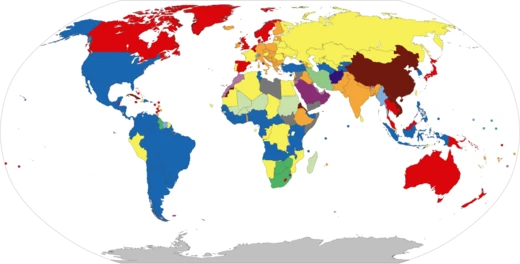
There are two main types: absolute and constitutional. In absolute monarchies, which number about a dozen, the ruler governs as an autocrat. Most modern monarchies are constitutional, where the monarch holds limited or no political power but retains unique legal and ceremonial roles under a constitution, similar to a head of state in a parliamentary republic. As of 2025, forty-three sovereign nations have a monarch, including fifteen Commonwealth realms that share King Charles III as their head of state. There are also various sub-national monarchical entities.
The word "monarch" entered English in the mid-15th century as "monark," meaning a supreme governor for life or sole autocratic ruler. It came from Old French, Late Latin, and ultimately Greek *monarkhos*, "one who rules alone." "Monarchy" appeared in the mid-14th century, referring to a kingdom or territory ruled by a monarch, and by the late 14th century also meant rule by a single person with supreme power. It derives from Old French, Late Latin, and Greek *monarkhia*, "absolute rule," from *monos* ("alone") and *arkhein* ("to rule").
The prehistoric form of societal hierarchy known as chiefdom or tribal kingship provided the concept of state formation, beginning with civilizations like Mesopotamia, Ancient Egypt, and the Indus Valley. In some regions, chiefdoms evolved into monarchies. Some of the oldest recorded monarchies include Narmer, Pharaoh of Ancient Egypt around 3100 BCE, and Enmebaragesi, a Sumerian King of Kish around 2600 BCE. From earliest records, monarchs could be directly hereditary or elected from eligible members. In some cultures—such as Egyptian, Chinese, Indian, Mesopotamian, Sudanic, and reconstructed Proto-Indo-European religion—the monarch held sacral functions connected to sac
- definition
- Hereditary head-of-state system
- types
- Absolute monarchy and constitutional monarchy
- current_count
- 43 sovereign nations as of 2025
- commonwealth_realms
- 15 share King Charles III as head of state
- etymology_origin
- Greek μόναρχος (monarkhos), 'one who rules alone'
- earliest_examples
- Narmer of Ancient Egypt c. 3100 BCE; Enmebaragesi of Sumer c. 2600 BCE
Lore & Background
The word monarch first appeared in English in the mid-15th century, derived from Greek roots meaning 'one who rules alone.' The term monarchy dates to the mid-14th century, originally referring to a kingdom or territory ruled by a monarch, and by the late 14th century also meant rule by a single person with supreme power. The similar form of societal hierarchy known as chiefdom or tribal kingship is prehistoric, and chiefdoms provided the concept of state formation that started with civilizations such as Mesopotamia, Ancient Egypt, and the Indus Valley civilization. Some of the oldest recorded monarchies were those of Narmer, Pharaoh of Ancient Egypt c. 3100 BCE, and Enmebaragesi, a Sumerian King of Kish c. 2600 BCE.
From the earliest records, monarchs could be directly hereditary, while others were elected from among eligible members. In some ancient societies, the monarch held sacral functions directly connected to sacrifice and was sometimes identified with having divine ancestry, possibly establishing a notion of the divine right of kings. Polybius identified monarchy as one of three 'benign' basic forms of government, opposed to tyranny. By the 17th century, monarchy was challenged by evolving parliamentarism and modern anti-monarchism, including the temporary overthrow of the English monarchy in 1649, the American Revolution of 1776, and the French Revolution of 1789.
Today, forty-three sovereign nations have a monarch, including fifteen Commonwealth realms that share King Charles III as head of state. Most modern monarchs are constitutional monarchs, retaining under a constitution unique legal and ceremonial roles but exercising limited or no political power. However, in some nations such as Morocco, Qatar, Liechtenstein, and Thailand, the hereditary monarch has more political influence than any other single source of authority in the state.
Reader's Guide
Monarchy has been a dominant form of government throughout history, shaping the political development of civilizations from ancient Egypt and Mesopotamia to the modern era. Its significance lies in its adaptability: from absolute autocracies to constitutional monarchies that function similarly to parliamentary republics. The decline of monarchy accelerated after World War I and World War II, as many countries replaced monarchies with republics. However, as of 2025, forty-three sovereign nations retain monarchs, demonstrating the system's persistence. According to a 2020 study, monarchy arose because of efficiency in governing large populations and expansive territories during periods when coordinating such populations was difficult, and declined as innovations in communications and transportation reduced that efficiency advantage. A 2023 study suggests monarchy has persisted because it can accommodate demands for democratization better than other forms of autocratic rule, by transitioning to a democratic constitutional monarchy while retaining the ruler. The distinction between absolute and constitutional monarchy remains central, with approximately twelve absolute monarchies existing today, while most modern monarchies are constitutional. The system's legacy includes both the divine right of kings and the modern crowned republic, illustrating its long evolution from ancient chiefdoms to contemporary governance.
Did You Know?
- The word 'monarchy' comes from Greek μοναρχία (monarkhia), meaning 'absolute rule,' literally 'ruling of one.'
- Some of the oldest recorded monarchies were those of Narmer of Ancient Egypt c. 3100 BCE and Enmebaragesi of Sumer c. 2600 BCE.
- Four elective monarchies exist today: Cambodia, Malaysia, the United Arab Emirates, and the papacy.
- According to a 2023 study, monarchy has persisted because it can accommodate demands for democratization better than other forms of autocratic rule.
More in Forms Of Government 1-20
Spotted an error? Know more?
This is a living reference — every entry is fact-audited, and reader corrections feed straight into our audit queue. Suggest an edit · See this site's audit record