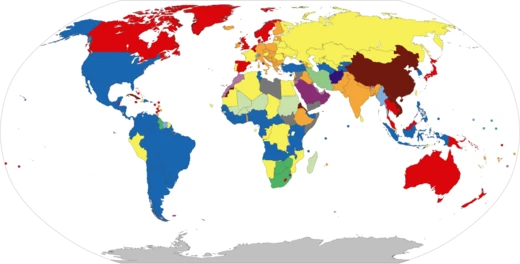
Head of government
Chief executive official presiding over a government cabinet.

Wikipedia / Wikimedia Commons
The head of government is the highest or second-highest official of a sovereign state, federated state, autonomous region, dependent territory, self-governing colony, or other government, often presiding over a cabinet of ministers or secretaries who lead executive departments. In diplomacy, the head of government is differentiated from the head of state, and the authority of the position varies greatly depending on the particular system of government.
- field
- Government and politics
- known_for
- Leading the executive branch and presiding over a cabinet
- common_titles
- Prime Minister, Chancellor, Premier, President of the Council of Ministers
Lore & Background
In communist states, the general secretary of the Communist Party serves as de facto head of state and government, while the de jure head of government may hold a different title, such as Premier in China. In directorial systems, like the Swiss Federal Council, executive responsibilities are spread among a group of people. Various titles exist for heads of government, including Chancellor, Chief Minister, First Minister, and Taoiseach.
Reader's Guide
The head of government is a central figure in the structure of modern states, embodying the executive authority that implements laws and directs policy. The position's significance lies in its variability: in parliamentary systems, the head of government is the political leader accountable to the legislature, while in presidential systems, the head of state and government are combined. This distinction shapes how power is balanced between branches of government. The role's importance is further highlighted by the diversity of titles and systems—from prime ministers in constitutional monarchies to presidents in republics, and from chancellors in German-speaking countries to the Taoiseach in Ireland. The head of government's relationship with the head of state and legislature determines the effectiveness of governance, as seen in cohabitation scenarios where divided control can lead to distinct policy domains. Understanding the head of government is essential for grasping how different political systems manage leadership, accountability, and the separation or fusion of powers.
Did You Know?
- The most common title for a head of government is Prime Minister.
- In parliamentary systems, the head of government is answerable to at least one chamber of the legislature.
- In semi-presidential systems like France, the president must choose a prime minister who enjoys the support of the National Assembly.
- In directorial systems, such as the Swiss Federal Council, executive responsibilities are spread among a group of people.
More in Forms Of Government 1-20
Spotted an error? Know more?
This is a living reference — every entry is fact-audited, and reader corrections feed straight into our audit queue. Suggest an edit · See this site's audit record