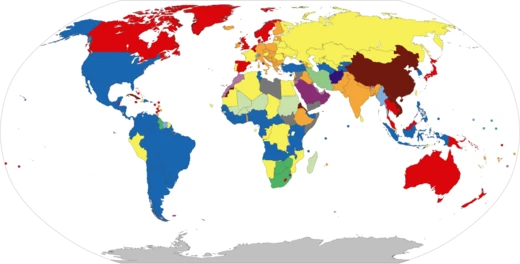
Government spending
Government spending drives fiscal policy and public goods provision.

Wikipedia / Wikimedia Commons
Government spending, also called public expenditure, encompasses all government consumption, investment, and transfer payments. It is a major component of gross domestic product, comprising final consumption expenditure and gross capital formation. Government spending is a key tool of fiscal policy used to stabilize the macroeconomic business cycle, and its role was notably emphasized by John Maynard Keynes in the 20th century.
- type
- Economic concept
- field
- Public economics, fiscal policy
- key_components
- Government final consumption expenditure, government investment (gross capital formation)
- key_theorist
- John Maynard Keynes
- related_principles
- Canons of public expenditure, principle of maximum social advantage
- fiscal_policy_types
- Expansionary and contractionary
Lore & Background
Government spending includes all government consumption, investment, and transfer payments. In national income accounting, acquisition of goods and services for current use is classed as government final consumption expenditure, while spending intended to create future benefits, such as infrastructure investment, is classed as government investment. Together, these form a major component of gross domestic product. Spending by a currency-issuing government is nominally self-financing, but under full employment, to avoid inflation, purchasing power must be removed via borrowing, taxes, fees, and other means.
Reader's Guide
Government spending is central to fiscal policy, with two main types: expansionary (increased spending or decreased taxes) to stimulate a recessionary economy, and contractionary (decreased spending or increased taxes) to cool an overheated economy and reduce inflation. Keynesian economics advocates deficit spending during contractions to raise aggregate demand and speed recovery, while classical economists argue it crowds out private investment by shifting resources from the productive private sector to the unproductive public sector. The principle of maximum social advantage, associated with Dalton and Pigou, holds that optimal welfare occurs when the marginal utility of expenditure equals the marginal disutility of taxation. Canons of public expenditure—such as benefit, economy, sanction, surplus, elasticity, productivity, and equitable distribution—guide spending policy, though some are debated.
Did You Know?
- Government spending includes both final consumption expenditure and gross capital formation, which together are a major component of GDP.
- Currency-issuing governments have infinite nominal fiscal capacity but face inflation constraints in practice.
- John Maynard Keynes argued that public expenditure is pivotal in determining levels of income and distribution in the economy.
- Automatic stabilizers like unemployment insurance change government spending without new laws, while discretionary stabilization requires legislative action.
More in Forms Of Government 1-20
Spotted an error? Know more?
This is a living reference — every entry is fact-audited, and reader corrections feed straight into our audit queue. Suggest an edit · See this site's audit record