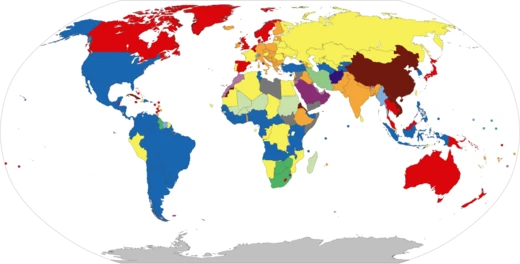
Popular sovereignty
Government legitimacy rests on the consent of the people.
Popular sovereignty is the idea that a state’s leaders and government are created and kept in power by the consent of the people, who are the ultimate source of political legitimacy. As a principle, it doesn’t require any specific political system. Benjamin Franklin captured it by saying that in free governments, rulers are servants and the people are their superiors and sovereigns.
The concept traces back to Marsilius of Padua’s 1324 work *Defensor pacis*, which stirred controversy by arguing that the people are the only legitimate source of political authority. He held that sovereignty rests with the people, who should elect, correct, and if needed remove their leaders. Later, the School of Salamanca—thinkers like Francisco de Vitoria and Francisco Suarez—developed the theory further. Like divine-right theorists and John Locke, they saw sovereignty as coming from God. But unlike divine-right theorists, and like Locke, they believed it passed from God to all people equally, not just to monarchs.
The modern sense of popular sovereignty comes from the social contract school: Thomas Hobbes, John Locke, and Jean-Jacques Rousseau. Rousseau’s *The Social Contract* highlighted the idea of the “general will.” The core belief is that a government’s authority and laws are legitimate only if the governed consent. All three thinkers held that individuals enter a social contract, giving up some natural freedom to gain protection from others’ freedoms. Whether people are seen as naturally violent (Hobbes) or cooperative (Rousseau), the idea that a legitimate social order requires equal liberties and duties ties them to popular sovereignty.
Republics and popular monarchies are theoretically based on this principle. But a legalistic notion of popular sovereignty doesn’t guarantee effective democracy. A party or dictator might claim to represent the people’s will and rule in their name—consistent with Hobbes’s view. Most modern definitions, however, treat democracy as a necessary condition. Judge Ivor Jennings called the idea that governments are created by consent “ridiculous,” noting that “the people cannot decide until somebody decides who are the people.”
In American history, popular sovereignty received special attention. Historian Christian G. Fritz’s study of early American constitutionalism shows how Americans tried to apply the doctrine before the Civil War. Po
- field
- Political theory
- known_for
- Principle that government legitimacy derives from consent of the governed
- key_early_advocate
- Marsilius of Padua (Defensor pacis, 1324)
- associated_thinkers
- Thomas Hobbes, John Locke, Jean-Jacques Rousseau
- notable_application
- American Revolution and 1850s U.S. slavery debates
Lore & Background
The origins of popular sovereignty trace to Marsilius of Padua's Defensor pacis (1324), which advocated republicanism and held that the people are the only legitimate source of political authority. The School of Salamanca, including Francisco de Vitoria and Francisco Suarez, further developed the theory, seeing sovereignty as emanating from God but passing to all people equally, not only to monarchs. In its modern sense, the idea dates to the social contract school of Thomas Hobbes, John Locke, and Jean-Jacques Rousseau, with Rousseau's The Social Contract highlighting the 'general will.' These thinkers held that individuals enter a social contract, voluntarily giving up some natural freedom for protection, and that a legitimate social order emerges only when liberties and duties are equal among citizens.
In American history, the doctrine received particular emphasis. The American Revolution marked a departure by substituting sovereignty in the person of King George III with a collective sovereign composed of the people. American revolutionaries generally agreed that governments were legitimate only if they rested on popular sovereignty. In the 1850s, Northern Democrats Lewis Cass and Stephen A. Douglas promoted 'popular sovereignty' as a middle position on slavery, arguing that white residents of territories should decide by vote whether to allow slavery. This led to the Kansas-Nebraska Act (1854), which allowed voting on slavery in Kansas and Nebraska, resulting in 'Bleeding Kansas' and the formation of the Republican Party.
Reader's Guide
Popular sovereignty is a foundational principle of modern democratic thought, asserting that political legitimacy derives from the consent of the governed. Its historical development spans from medieval republicanism through the social contract theorists to its practical application in the American Revolution and the 1850s U.S. slavery debates. The principle does not inherently require democracy; a dictator or party may claim to represent the people's will, as Hobbes suggested. Most modern definitions, however, present democracy as a necessary condition. The American attempt to apply popular sovereignty to the slavery question in Kansas led to violent conflict and political realignment, illustrating both the power and the peril of the doctrine. Judge Ivor Jennings criticized the notion as 'ridiculous,' arguing that 'the people cannot decide until somebody decides who are the people.' The principle remains central to debates about self-governance, legitimacy, and the nature of political authority.
Did You Know?
- Marsilius of Padua's Defensor pacis (1324) advocated that the people are the only legitimate source of political authority.
- The School of Salamanca saw sovereignty as passing from God to all people equally, not only to monarchs.
- In the 1850s, Stephen A. Douglas applied 'popular sovereignty' to Kansas via the Kansas-Nebraska Act, leading to 'Bleeding Kansas.'
- Judge Ivor Jennings called the notion that governments are created by consent of the people 'ridiculous.'
More in Forms Of Government 1-20
Spotted an error? Know more?
This is a living reference — every entry is fact-audited, and reader corrections feed straight into our audit queue. Suggest an edit · See this site's audit record