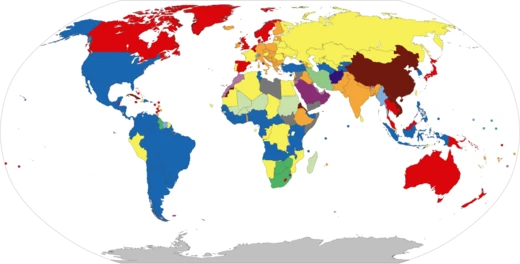
One-party state
A system where only one party controls the ruling structure.
A one-party state, also called a single-party system, is a form of government where only one political party holds power. In these states, opposition parties are either banned or allowed only limited, controlled participation in elections. The phrase "de facto one-party" can refer to a dominant-party system that nominally permits multiparty elections, but where the actual political dynamics or power balance prevent the opposition from ever winning.
The ruling party’s membership is often small relative to the total population, though this is not always the case—some one-party states, like Zaire under Mobutu, made every citizen a party member. Instead of broad inclusion, these regimes typically distribute private benefits to allied elites to secure their loyalty. Compared to dominant-party dictatorships, one-party states are structured differently from democracies and are less likely to transition into multiparty democracies. Although they ban opposition parties, some allow independent candidates to run against party candidates in elections. This lets the ruling party place elites and sympathetic figures in key administrative roles. For instance, the Chinese Communist Party maintains political control by infiltrating village administrations, viewing these positions as essential for gathering information on the population and maintaining a presence in remote areas.
One-party states recognize a trade-off between winning elections and collecting useful data. To manage this, they sometimes put local nobility in races that are easy to win. They also use elections to ensure only the most popular elites are selected for office, and they gather data from elections to identify local officials who are performing poorly in the eyes of residents. This gives locals a chance to monitor officials and express satisfaction with local government. Across the country, members of the single party hold key political positions. In this way, the party avoids outright fraud and instead sustains its power at the local level through strategic appointments of elites. Data on one-party governments can be hard to obtain due to their lack of transparency.
- definition
- Governance structure with only one ruling party
- key feature
- Opposition parties outlawed or heavily restricted
- membership
- Often small relative to population, but not universal
- example
- Zaire under Mobutu made entire citizenry party members
- election role
- Used to gather data and monitor local officials
- transparency
- Data on one-party governments can be difficult to gather
Lore & Background
One-party states structure themselves unlike democracies and turn into multi-party democracies at a lower rate than dominant-party dictatorships. While they prohibit opposition parties, some allow independent candidates to stand for election in competition with party candidates. They place elites and sympathetic candidates in key administrative races; for example, the Chinese Communist Party exercises political control by infiltrating village administrations, viewing these positions as crucial for gathering information on the population and maintaining a presence in far reaches of their borders.
Reader's Guide
One-party states recognize a trade-off between election victory and gathering valuable data. To account for this, governments have been observed placing local nobility in easy-to-win races and using elections to ensure that only the most popular elites get chosen to office. They also gather data from elections to indicate if a local official is performing poorly in the eyes of residents, giving locals the opportunity to monitor officials and communicate satisfaction. Throughout the country, members of the one party hold key political positions, avoiding outright fraud and sustaining power at the local level with strategic appointment of elites. The lack of transparency in one-party governments makes data on them difficult to gather. Their significance lies in their persistence and lower rate of transition to multiparty democracy compared to dominant-party dictatorships.
Did You Know?
- Some one-party states, such as Zaire under Mobutu, made the entire citizenry members of the party.
- One-party states turn into multi-party democracies at a lower rate than dominant-party dictatorships.
- One-party states have been observed using elections to ensure only the most popular elites get chosen to office.
- Data on one-party governments can be difficult to gather given their lack of transparency.
More in Forms Of Government 1-20
Spotted an error? Know more?
This is a living reference — every entry is fact-audited, and reader corrections feed straight into our audit queue. Suggest an edit · See this site's audit record