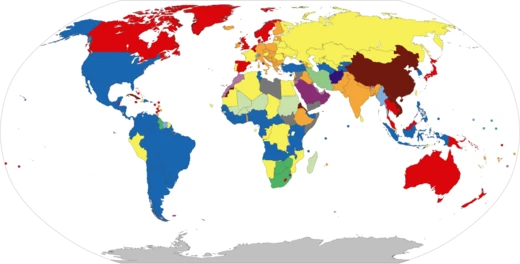
Liberal democracy
A government combining democracy with liberal political philosophy.
Liberal democracy, also called Western-style democracy, is a form of government that combines the organization of a democracy with ideas of liberal political philosophy. Common elements include representative democracy with multiple viable political parties and universal suffrage; separation of powers; the rule of law; a market-based capitalist economy with private property; and state-guaranteed protections for human rights, civil rights, civil liberties, and political freedoms. Liberal democracy traces its origins to the Age of Enlightenment in 18th-century Europe, where Enlightenment intellectuals challenged conventional views supporting monarchies and aristocracies, arguing that human affairs should be guided by reason and principles of liberty and equality.
- field
- Political system
- origins
- Age of Enlightenment, 18th-century Europe
- key_elements
- Representative democracy, separation of powers, rule of law, market-based capitalist economy, protected rights and freedoms
- contrasted_with
- Illiberal democracies, hybrid regimes, dictatorships, direct democracies, socialist democracies
- known_for
- Combining democracy with liberal philosophy; constitutional government; correlation with political stability, lower corruption, better resource management, and improved health indicators
Lore & Background
Liberal democracy emerged from Enlightenment thought, with thinkers such as John Locke arguing that all people are created equal, governments exist to serve the governed, and laws must apply equally to rulers and citizens. On the European continent, Montesquieu's The Spirit of the Laws advanced separation of powers, Rousseau's The Social Contract articulated popular sovereignty and the 'general will', and Voltaire championed freedom of conscience and expression. These ideas influenced the American Revolution and the French Revolution, which gave birth to the philosophy of liberalism and instituted forms of government attempting to put Enlightenment principles into practice. When the first prototypical liberal democracies were founded, liberals were viewed as an extreme and dangerous fringe group threatening international peace and stability. Conservative monarchists saw themselves as defenders of traditional values, and their criticism seemed vindicated when Napoleon Bonaparte took control of the young French Republic and conquered most of Europe. After Napoleon's defeat, the Holy Alliance formed to prevent further spread of liberalism or democracy, but liberal democratic ideals soon became widespread among the general population. Over the 19th century, traditional monarchy was forced on a continuous defensive and withdrawal. The Dominions of the British Empire became laboratories for liberal democracy from the mid-19th century onward, with responsible government in Canada beginning in the 1840s and parliamentary government elected by male suffrage and secret ballot established in Australia and New Zealand from the 1850s, with female suffrage achieved from the 1890s.
Reader's Guide
Liberal democracy became a prevalent political system in the world after a period of expansion in the second half of the 20th century. It is contrasted with illiberal democracies, hybrid regimes, and dictatorships, as well as direct democracies and socialist democracies. Relative to authoritarian regimes, the characteristics of liberal democracies are correlated with increased political stability, lower corruption, better management of resources, and better health indicators such as life expectancy and infant mortality. Some liberal democracies, especially those with large populations, adopt federalism as a vertical separation of powers to prevent abuse and increase public input. Liberal democracy may take various forms, including constitutional monarchic or republican systems; parliamentary, presidential, or semi-presidential governmental systems; and common, civil, or customary legal systems. The relationship between democracy and liberalism has been controversial since the beginning and was problematized in the source article, though the article does not resolve this dispute. By the end of the 19th century, liberal democracy was no longer only a liberal idea but supported by many different ideologies, and after World War I and especially World War II, it achieved a dominant position among theories of government.
Did You Know?
- Liberal democracy traces its origins to the Age of Enlightenment in 18th-century Europe.
- John Locke argued that all people are created equal and that governments exist to serve the governed.
- Montesquieu's The Spirit of the Laws advanced the doctrine of separation of powers.
- Liberal democracies are correlated with increased political stability, lower corruption, and better health indicators such as life expectancy and infant mortality.
More in Forms Of Government 1-20
Spotted an error? Know more?
This is a living reference — every entry is fact-audited, and reader corrections feed straight into our audit queue. Suggest an edit · See this site's audit record