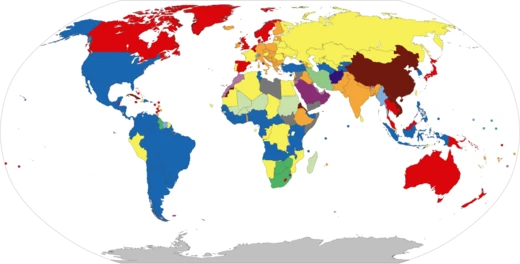
Frequently Asked Questions
The most-asked questions about forms of government.
What exactly is a 'form of government'?
A form of government is the structural framework that defines who holds power, how decisions are made, and how authority is distributed within a state. It covers everything from who leads (a hereditary king, an elected president, a council) to how that leader is chosen and held accountable.
What are the main archetypes in the forms-of-government lineup?
The core types include democracy (rule by the people), monarchy (rule by a hereditary sovereign), oligarchy (rule by a small elite), theocracy (rule by religious authority), and autocracy (rule by a single unelected leader). Most modern states are hybrids that blend elements from several of these categories.
Who are the key thinkers a newcomer should know?
Aristotle, who first systematically classified governments in his work Politics, and John Locke, whose ideas on natural rights and consent shaped modern democratic theory, are the two most foundational figures. Montesquieu's separation of powers and Machiavelli's pragmatic analysis of statecraft round out the essential reading list.
Where should a total beginner start exploring this topic?
Begin with Aristotle's simple three-fold classification (one ruler, a few rulers, many rulers) to build a mental map, then look at how each type appears in a country you already know. From there, move into specific constitutions or founding documents to see the theory applied in practice.
What is the practical difference between a republic and a democracy?
A democracy emphasizes direct or representative popular rule, while a republic specifically means the state is a 'public matter' governed by elected officials operating under a written constitution that limits their power. In practice the terms overlap heavily, since most modern democracies are also republics.
How do you tell a constitutional monarchy apart from an absolute one?
In a constitutional monarchy the sovereign's powers are defined and limited by a constitution or legal framework, as in the United Kingdom or Japan. In an absolute monarchy the ruler holds supreme, unchecked authority over law and policy, a system that has largely disappeared from the modern world.
What is an oligarchy, and how does it differ from an aristocracy?
An oligarchy is rule by a small group selected by wealth, corporate influence, or military control, whereas an aristocracy historically refers to rule by a hereditary noble class. In modern usage the terms often overlap, but oligarchy carries a stronger connotation of unelected, self-serving power.
What are some notable moments when a form of government changed dramatically?
The 1789 French Revolution replaced an absolute monarchy with a republic, and the 1947 Indian Constitution transformed a British colonial dominion into the world's largest democracy. The 1989 fall of the Berlin Wall similarly ended decades of one-party authoritarian rule across Eastern Europe.
What is the most common form of government in the world today?
Presidential or parliamentary republics account for the vast majority of sovereign states, with roughly 160 of 195 countries operating some version of elected representative government. A small number of hereditary monarchies and a handful of one-party states make up the remainder.
Can a single country mix multiple forms of government?
Yes—most real-world systems are composites rather than pure types. The United Kingdom, for example, blends a hereditary monarchy with a parliamentary democracy and an unwritten constitutional tradition, while South Korea pairs a presidential system with a strong judicial-review tradition inherited from its post-war constitution.